
El acuerdo de los parquímetros de Chicago: lo que la ciudad obtuvo y lo que cedió
- En 2008, Chicago arrendó sus parquímetros a una empresa privada por 75 años y recibió más de $1,150 millones por adelantado. El arrendamiento vence a principios de 2084.
- Newsbeeper revisó 17 años de estados financieros auditados de la empresa. Sus dueños invirtieron $1,190 millones y retiraron $1,760 millones, y cerca de $1,900 millones que los conductores pagaron en los parquímetros fueron a parar a la empresa.
- A finales del año pasado, la ciudad intentó recomprar los parquímetros, con una oferta final de $3,200 millones, según dijo un abogado de la ciudad. El alcalde la abandonó. En octubre, Stonepeak terminó de comprar la empresa; le había dicho al Concejo Municipal que el precio sería de $2,530 millones. El arrendamiento no cambió.
Por qué importa: Cuando usted paga por estacionarse en un parquímetro de Chicago, la mayor parte de ese dinero va a una empresa privada, y así será hasta 2084. Cada año, los conductores ahora pagan en los parquímetros más del doble que en 2010 ($161 millones frente a $71 millones, sin ajustar por inflación). Y cuando la ciudad cierra demasiados espacios con parquímetro por obras en las calles o festivales, también tiene que pagarle a la empresa.
Reportado por Newsbeeper · Aprobado por Kayhan Kirmizigul
Get Chicago news every morning, free
Tu barrio, cinco historias y el clima, cada día entre semana a las 6 a.m. Gratis. Cancela tu suscripción con un clic, cuando quieras.
In 2008, Chicago leased its parking meters for $1.15 billion. Late last year, the city offered $3.2 billion to get them back, then dropped the offer, a city lawyer said. That is almost three times what it got, though those are dollars from different years.
Newsbeeper reviewed 17 years of audited financial records to trace how much investors put into Chicago's parking meter company, how much they took out and what the city gave up in a 75-year deal that runs until 2084.
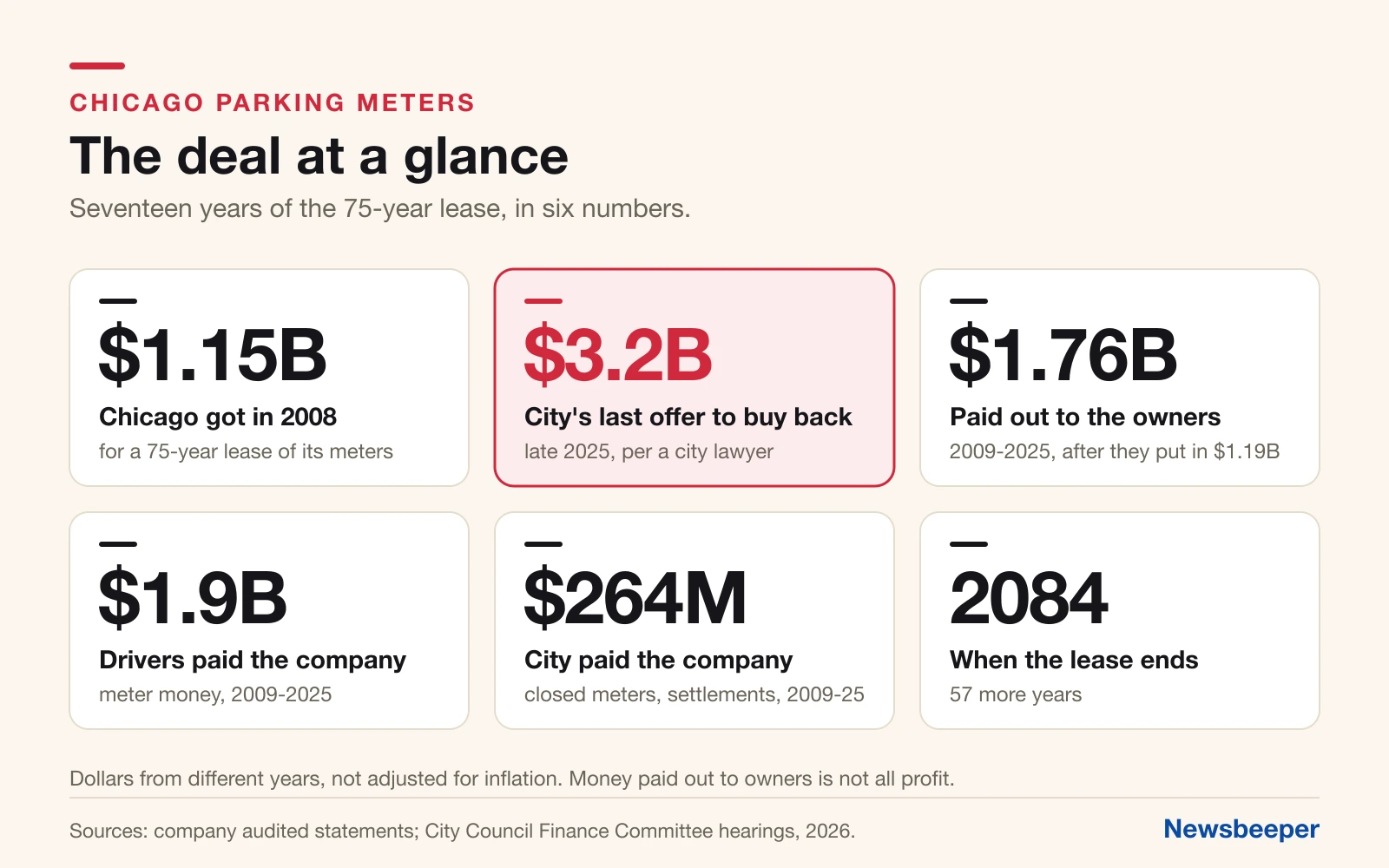
In December 2008, Chicago was short on money. The City Council voted 40 to 5 to lease the city's roughly 36,000 metered parking spaces to a new company, Chicago Parking Meters LLC, for 75 years. The agreement paid the city about $1.16 billion; the company's books record the price as $1.15 billion.
The warning in 2009
Six months after the vote, the city's own watchdog, the Inspector General, said Chicago had been paid too little. His office figured the meters were worth about $2.13 billion to the city over 75 years, about $974 million more than it got. Using a lower discount rate, like the one the federal government uses, the office said the value would have been about $3.53 billion.
What the owners put in and took out
In 2009 the owners put $1.19 billion into the company, mostly to pay the city. By 2017, they had taken out more than that, according to the company's statements. By the end of 2025, they had taken out $1.76 billion.
That money is not all profit. Over those 17 years, the company's own books show about $433 million in total profit after interest and other costs. The rest gave the owners back what they had put in, and more. Much of that was paid for with borrowed money: the company took on loans in 2010 and 2019 around the time of large payouts, and it owed about $1.06 billion at the end of 2025.
What the original owners earned in the end depends on how much of Stonepeak's price reached them and what happened to the company's debt in the sale. Neither has been made public.
Distributions are not the same as profit. They include returned capital and payments funded in part by borrowing. Source: the company's audited financial statements, 2009-2025; Newsbeeper analysis.
What if the city had kept the meters?
Somebody has to fix the meters, buy new equipment, run the pay boxes and pay the card fees, no matter who owns them. So we took the cash the company had left after those costs, before interest on its loans, and left out the money the city paid the company. That is roughly what the city could have kept if it had run the meters itself at the same prices, with the same number of drivers.
From 2009 to 2025, that comes to about $1.3 billion, more than the city got up front. And the city would still own the remaining 57 years, which Stonepeak agreed to pay $2.53 billion for, according to the sale proposal described at a Finance Committee hearing.
These two numbers show how valuable the meters are. But they cannot simply be added up to measure what the city lost. One is money over the past 17 years, the other is a price for the next 57, and a dollar received in 2008 was worth more than a dollar received years later. A city running the meters might also have charged less, or spent more on staff.
What you pay at the meter
Before the deal, a neighborhood meter cost 25 to 75 cents an hour. Today it is $2.50. In the Loop, it went from $3 an hour to $7.
Here is about how much drivers put into Chicago's meters each year that ended up with the company:
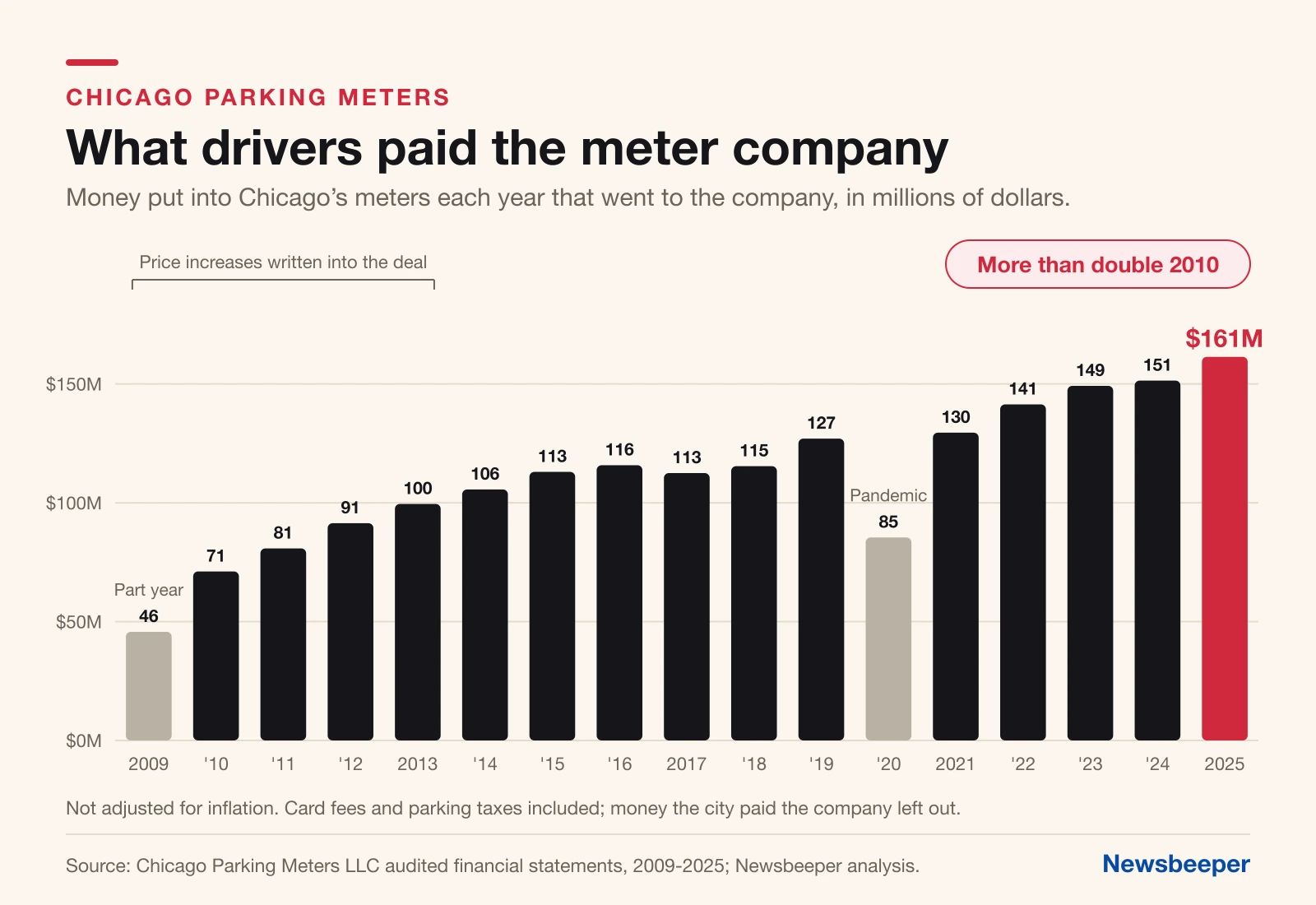
Source: the company's audited financial statements. The company's total parking revenue from 2009 through 2025 was about $2.16 billion. About $264 million of that came from the city, so we left it out; the rest, about $1.9 billion, came from drivers. Card fees and parking taxes are still in. The city keeps parking-ticket money and the money from a small number of meters it held onto.
The city pays too
The deal has a catch. When the city takes more metered spaces out of service in a year than the contract allows, for road work or a street festival, it has to pay the company for the parking money it lost. These are called "true-up" payments.
From 2009 through 2025, the company recorded about $172 million in these payments. The City Council's budget office counted about $161 million through 2024. Add other payments, like covering free parking for drivers with disability placards from 2011 to 2016 and a $15.5 million settlement last year, and the city's payments to the company come to about $264 million, according to the company's statements.
Why didn't the city get the meters back?
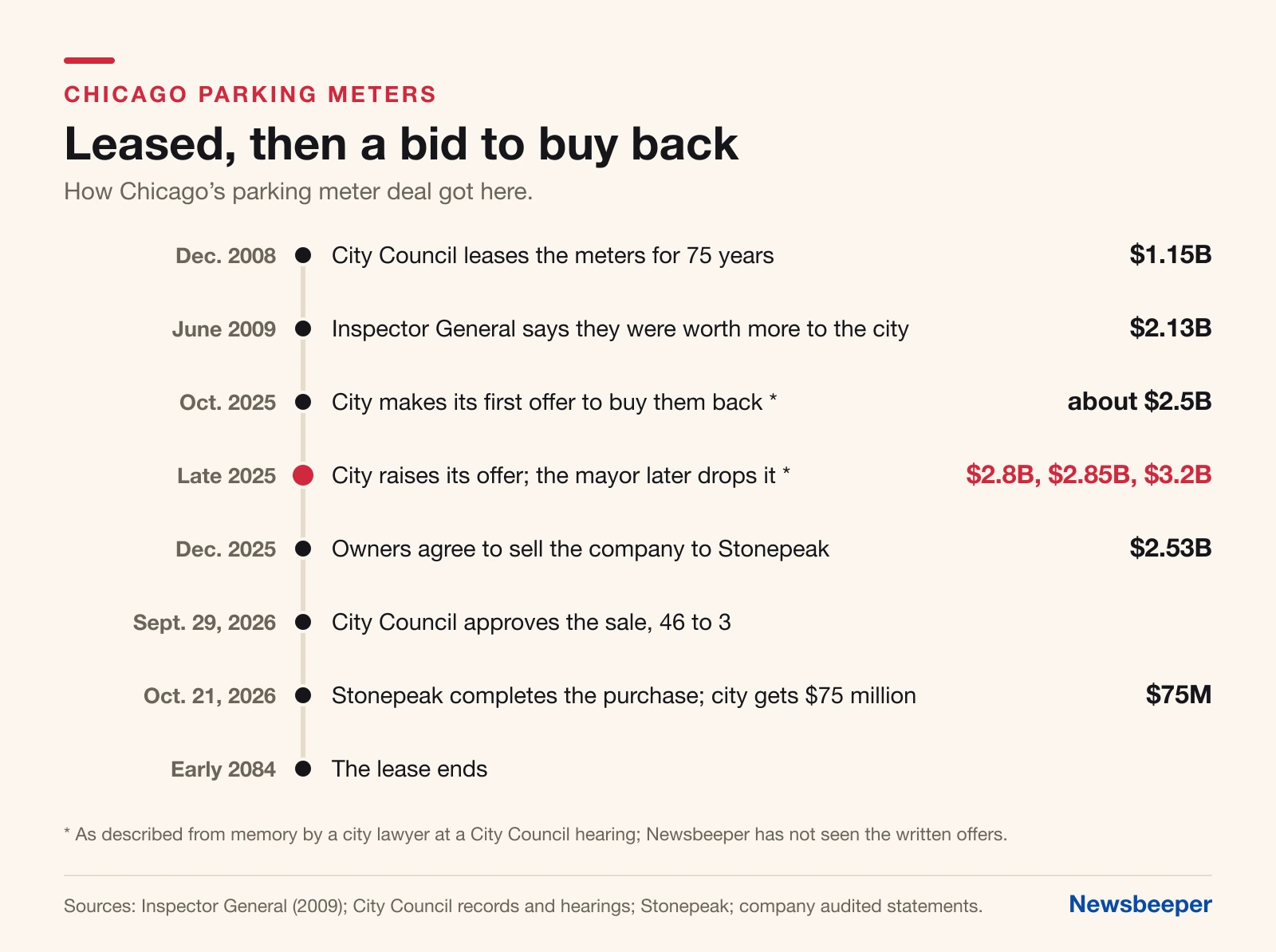
At a City Council Finance Committee hearing in September, James McDonald, a lawyer in the city's Law Department who worked on the deal, told aldermen the city had tried to buy the meters back starting in October 2025. Going from memory, he said the city offered about $2.5 billion, then about $2.8 billion, then about $2.85 billion. The city was told it had to go to at least $3 billion, he said, so it offered $3.2 billion. Any deal would have needed the City Council's OK, and the council never voted on one. "The mayor decided not to proceed with it," McDonald said. He did not say why. A Stonepeak executive had earlier put the city's offer at $3.3 billion. Newsbeeper has not seen a written copy of the city's offers.
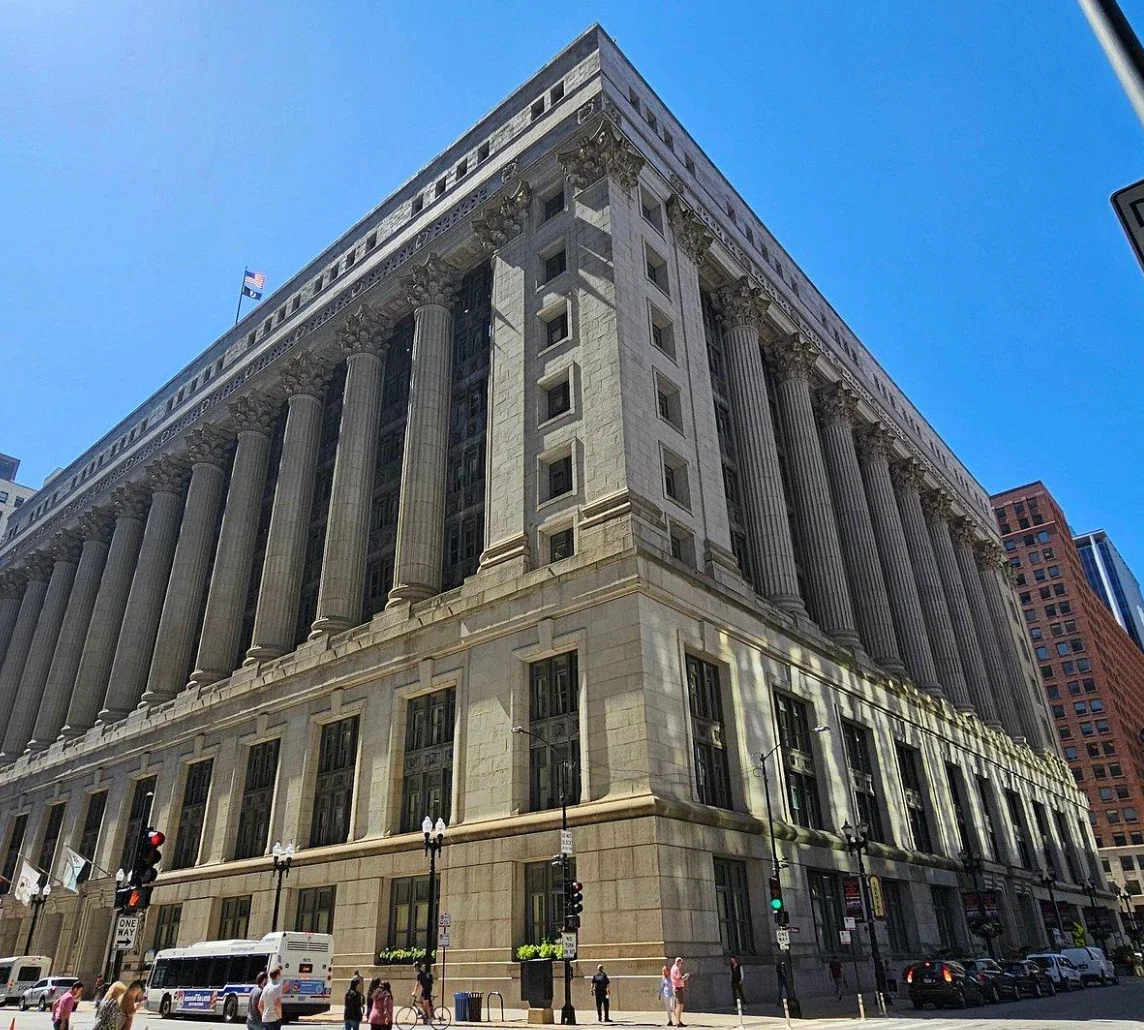
At a June Finance Committee hearing, Stonepeak said its own offer was $2.53 billion. A Stonepeak executive also said that, from what his firm knew, the city planned to borrow, in effect, the entire price through city bonds, which he called imprudent given the city's finances. Keep in mind Stonepeak was bidding against the city.
At both hearings, aldermen said they had not been told the city was bidding. The city has not said publicly why it was willing to pay $3.2 billion, how it would have paid for it, or why it stopped.
The company changed hands. The lease didn't.
The City Council approved Stonepeak's purchase 46 to 3 on Sept. 29. Stonepeak said it completed the purchase on Oct. 21. The company today runs more than 38,000 metered spaces, Stonepeak said.
Stonepeak bought the company, not the city's meters. The lease still runs until early 2084, and drivers still pay the company.
As part of the sale, the city got $75 million from the company. A city ordinance says that money has to go to the police, fire and other city pension funds by Dec. 31. From now on, the company also has to give the city 5% of its profit each year, and 2% of the price if it is ever sold again. The contract defines that profit as the net income in the company's audited financial statements, after interest and other costs, with one change: management fees paid to Stonepeak-controlled companies above the previous year's level, adjusted for inflation, are added back if they are not at arm's length. Applied to 2025, 5% of the company's reported profit would have been about $3.6 million. Because the profit is counted after interest, more borrowing by the new owner could mean a smaller payment for the city. Each payment is due within 150 days after the year ends; the city has not said when the first one comes. The city can also now close meters for up to 10 hours during seven big yearly events, such as the Pride Parade and the Bud Billiken Parade, without it counting as a full-day closure. If that pushes the city over its yearly limit, it may still owe the company for those hours, paid out of credits and money otherwise due the city.
What the courts said
Two big lawsuits have challenged the deal. Both lost.
In 2014, an Illinois appeals court said the deal was legal. But it said the city had kept control of its meters "although at a cost," and told the city "to debate and act wisely in the future."
In 2023, a federal appeals court wrote that "the deal itself might have been foolish, short-sighted, or worse," but that was not enough for drivers to win their antitrust case. The U.S. Supreme Court would not hear it.
What drivers could pay before the lease ends
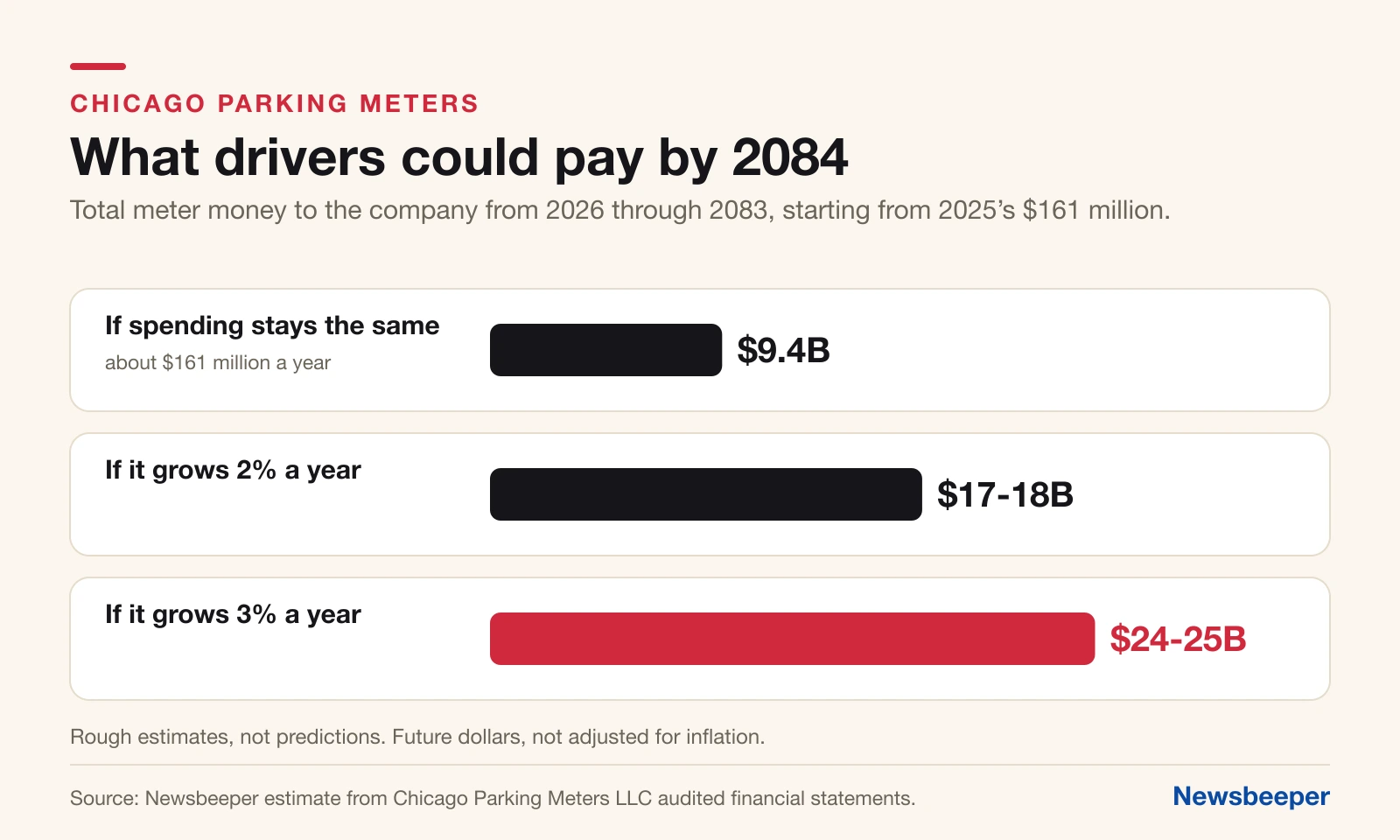
Nobody knows for sure. But here is a rough idea, starting from what drivers paid in 2025, about $161 million.
If drivers keep paying the same amount every year, that would be about $9.4 billion more from 2026 through 2083. If it rises 2% a year, about $17 billion to $18 billion; at 3% a year, about $24 billion to $25 billion. These are rough estimates, not predictions, and they are not adjusted for inflation.
Chicago Office of Inspector General, "An Analysis of the Lease of the City's Parking Meters," June 2, 2009 igchicago.org/…
Chicago Parking Meters LLC, audited financial statements 2009-2025, filed with the city chicago.gov/…
City Council Committee on Finance, hearing video, June 25, 2026 vimeo.com/showcase/8928482?video=1204299658
City Council Committee on Finance, hearing video, Sept. 24, 2026 vimeo.com/manage/videos/1229670520
Chicago City Clerk, SO2026-0025407 (sale approval, vote record) and O2026-0029681 (pension payment) chicityclerkelms.chicago.gov/…
City Council Office of Financial Analysis, "Parking Meters: 'True Up' Payments" (2025)
Illinois Appellate Court, IVI-IPO v. Ahmad, 2014 IL App (1st) 123629 illinoiscourts.gov/…
U.S. Court of Appeals for the Seventh Circuit, Uetricht v. Chicago Parking Meters LLC, No. 22-1166 (2023); U.S. Supreme Court docket 23-366
ParkChicago, Rates & Hours parkchicago.com/rates-hours
Stonepeak, "Stonepeak Completes Acquisition of Chicago Parking Meters," Oct. 21, 2026 stonepeak.com/…
¿Encontraste un error? Cuéntanos y lo corregiremos en público. Ver todas las correcciones.
Recibe Chicago en tu correo
Tu barrio, cinco historias y el clima, cada día entre semana a las 6 a.m. Gratis. Cancela tu suscripción con un clic, cuando quieras.
Más rápido en WhatsApp
Envía fotos, videos o una ubicación directamente a nuestros editores.